
JOURNAL
Notes on listening,
place, music, and practice.
理念を捨てず、現実を共有する。
Holding on to Our Principles, Sharing the Same Reality
JP / EN
明日、ここ石垣島では選挙がある。
その前夜というより、もう朝に近い時間に、ニューヨーク・タイムズのLulu Garcia-NavarroによるZohran Mamdaniへのインタビューについて考えている。
この対話に、勝者はいなかった。
少なくとも私には、そう見えた。
LuluはMamdaniを論破しようとしているようには見えなかったし、Mamdaniも自分の正しさを証明しようとしているようには見えなかった。そこにあったのは、もっと難しいことだった。
理念を持ったまま、異なる人々とひとつの社会をつくることはできるのか。
ガザについて問われる。
ジェノサイドをジェノサイドと呼ぶのか。
ニューヨーク市長であるならば、ユダヤ人のコミュニティも、アラブやムスリムのコミュニティも、同じ街に暮らすすべての人を守らなければならない。
それでも、言うのか。
その緊張の中で、Mamdaniは普遍的な人権という場所へ戻ろうとする。
パレスチナ人の権利を守ることは、パレスチナ人だけのためではない。
ある人間の権利に例外をつくれば、やがて人権という考えそのものが壊れてしまう。
だから、誰かの人権を守ることは、すべての人の人権を守ることにつながる。
同時に、理念だけでは都市を運営できない。
家賃を払えること。
子どもを育てられること。
安全に街を歩けること。
異なる背景を持つ人々が、
同じ街で暮らし続けられること。
Affordable Cityという言葉が、
そこで理念から現実へ降りてくる。
私は、この二つの間に生まれる張力こそが民主主義なのかもしれないと思った。
理念を捨てないことと、
異なる立場の人々と現実を共有すること。
どちらか一方を選べば、ずっと簡単になる。
理念だけなら、正しいことを言い続けられる。
現実だけなら、仕方がないと言い続けられる。
けれど民主主義は、そのどちらにも逃げられない。
思えば、この感覚を私は12歳の頃に知っていた。カナダのアルバータにいた頃、クラスで喧嘩やいじめが起こると、みんなで話し合った。
私は小さなアジア人の子どもだった。
意見は違った。
傷つくこともあった。
うまく話せないこともあった。
それでも、次の日も同じ教室にいた。
誰が完全に正しいかを決めて終わるのではなく、違う人間同士が、これからも同じ場所で生きていくために話す。
あの頃は、それを民主主義だとは思っていなかった。けれど今になって思う。
もしかすると、あれが私にとって最初の民主主義だったのかもしれない。 最近見直していた The Morning Show にも、同じ緊張を感じた。
真実を語ること。
誰かを守ること。
組織を維持すること。
権力を疑うこと。
どれか一つだけを選べば済む世界ではない。
そして今朝、遠くニューヨークで交わされた二人の対話を見ながら、私はその感覚をもう一度思い出した。
民主主義とは、
意見が一致することではないのかもしれない。
対立がなくなることでもない。
むしろ、
異なるままで、同じ現実から立ち去らないこと。
自分の理念を持つ。
相手にも、
その人が生きてきた現実があることを知る。
問いかける。
聴く。
必要なら反対する。
それでも、同じ社会をつくる方法を探し続ける。
それは、とても疲れる。けれど、おそらくその疲労を誰か一人に押しつけず、みんなで引き受けるために、民主主義という仕組みがある。
明日、私はこの島で選挙を迎える。
ニューヨークと石垣島では、人口も歴史も抱えている問題もまったく違う。
けれど、ひとつだけ持っていきたい問いがある。
私たちは、どんな社会なら、
異なるまま一緒に生きていけるのだろう。
答えは、まだない。
だから、投票する。
そして投票したあとも、
見る。
聴く。
考える。
話す。
民主主義は、
投票箱のところで
完成するものではないのだと思う。
それはきっと、
翌朝からまた始まるPracticeなのだ。
EN
Tomorrow, there is an election here in Ishigaki.
And in these hours before morning, I find myself thinking about Lulu Garcia-Navarro’s interview with Zohran Mamdani for The New York Times.
No one won that conversation.
At least, that's how I saw it.
Lulu did not seem interested in defeating Mamdani in an argument. Nor did Mamdani seem interested in simply proving he was right.
Something more difficult was happening between them.
Can we hold on to our principles and still build a society with people who do not share them?
He is asked about Gaza.
Do you call genocide genocide?
A mayor of New York must protect Jewish communities, Arab and Muslim communities, and everyone else who calls the same city home.
Do you still say it?
Within that tension, Mamdani keeps returning to the idea of universal human rights.
Protecting the rights of Palestinians is not only about Palestinians.
The moment we create an exception to the rights of one group of human beings, we begin to weaken the very idea of human rights itself.
To protect someone’s human rights, then, is ultimately to protect everyone’s.
And yet principles alone cannot govern a city.
People need to pay their rent.
To raise their children.
To walk safely through their neighborhoods.
To continue living alongside people whose histories, beliefs, and identities may be very different from their own.
This is where the idea of an “affordable city” brings principle back down into everyday life.
I began to think that perhaps democracy lives precisely in the tension between these two things:
holding on to our principles, and sharing reality with people who see the world differently.
Choosing only one would be much easier.
With principles alone, we can keep saying what is right.
With reality alone, we can keep saying that nothing else is possible.
Democracy allows us to escape neither.
I realize now that I encountered something like this when I was twelve.
I was living in Alberta, Canada. When there was a fight or bullying in our class, we talked about it together. I was a small Asian kid. We disagreed.
Sometimes people got hurt. Sometimes we did not know how to say what we meant. And yet, the next morning, we were all back in the same classroom.
The purpose was not simply to decide who was completely right and then move on.
We talked because people who were different from one another still had to find a way to inhabit the same place.
At twelve, I did not call that democracy.
Looking back now, perhaps it was my first experience of it. Recently, rewatching The Morning Show, I felt something similar.
Tell the truth.
Protect someone.
Keep an institution functioning.
Question power.
It is a world in which choosing only one is rarely enough.
And this morning, watching two people in New York remain inside a difficult conversation, I remembered that feeling again.
Perhaps democracy is not agreement.
Perhaps it is not the absence of conflict.
Perhaps it is something closer to this: remaining in the same reality, even when we remain different.
To have principles of our own.
To recognize that another person has a reality shaped by a life we have not lived.
To ask.
To listen.
To disagree when necessary.
And still to keep looking for a way to make a society together.
It is exhausting. But perhaps democracy exists so that the exhaustion of living together does not have to be carried by one person alone.
Tomorrow, I will encounter an election on this island.
New York and Ishigaki could hardly be more different in scale, history, and circumstance.
Still, there is one question I want to carry with me:
What kind of society would allow us to remain different, and still live together?
I do not have the answer.
So I vote.
And after voting, I keep watching. Listening. Thinking. Talking.
Democracy does not become complete at the ballot box.
Perhaps it is a practice that begins again the morning after.
音が前に出すぎない場所で
In Places Where Sound Does Not Push Itself Forward
JP / EN
“A Paradise Where Music and Art Meet Postcard Mountain Views”
By David Allen / Visuals by Will Warasila
Published September 9, 2026
まず心を奪われたのは、演奏でも建築でもなく、メインスピーカーの仕込み方だった。大きなPAが空間を支配しているのではない。音響も照明も、そこに「あります」と主張していない。それでも、音楽のための条件は、驚くほど高い精度で整えられている。
あとで知ったのだが、この空間――Tippet Rise Art CenterのOlivier Music Barn――には、Alcons AudioのLR14/90が8台、LR14/120が2台、BF151 compact subwooferが4台、Sentinel10 amplified loudspeaker controllerが2台というシステムが組まれているという。
さらに録音環境も非常に充実していて、9チャンネルのマイクアレイ、7.1.4のGenelecモニタリング、Merging Technologies Pyramixによる高解像度収録まで備えている。数字だけ見れば、かなり本格的なシステムだ。でも、写真から伝わってくるのは、機材の強さではない。むしろ逆で、これほどの技術がありながら、技術が前に出てこないことに惹かれる。
音楽が主役であり、
演奏者が主役であり、
木の空間が主役であり、
その場で耳を澄ませる人の時間が主役である。
音響は、それを壊さない。
照明も、それを壊さない。
建築と風景も、消されない。
私はたぶん、こういう世界へ戻りたいのだと思う。
いや、「戻る」というより、島で過ごした時間のなかで自分が学んだことを持って、もう一度、こういう世界へ入っていきたいのだと思う。
自然を主役にするために音楽がある。
場所に耳を澄ますために、演出がある。
人を圧倒するためではなく、
人が深く聴けるように、音と光が整えられている。
そういう考え方に、私は深く惹かれる。
この写真を見ながら、あらためて自分に問いが生まれた。
自分は、どんな場所なら深く仕事ができるのか。
どんな人たちとなら、
音楽を中心に世界をつくれるのか。
何を増やす仕事ではなく、
何を残す仕事がしたいのか。
たぶん私は、
音を足しすぎない場所、
光を当てすぎない場所、
人を集めすぎない場所で、
深く仕事ができる。
派手な演出よりも、
その土地にすでにあるものを消さずに残すこと。
建築、風、空、光、沈黙、そして人の気配。そういうものと音楽が、無理なく一緒に存在できる場をつくりたい。
そして一緒に仕事をしたいのは、
何かを「盛る」ことよりも、
何を残すべきかを考えられる人たちだ。
音楽をコンテンツとして消費するのではなく、
音楽を中心に、人と場所の関係を丁寧に編んでいける人たち。技術を誇示するためではなく、聴くことの条件を整えるために技術を使える人たち。そういう人たちとなら、きっと私は深く仕事ができる。
何を増やすかではなく、
何を残すか。
その問いは、
これから自分がどこへ向かうのかを決める
とても静かで、
とても大切な基準になる気がしている。
EN
“A Paradise Where Music and Art Meet Postcard Mountain Views”
By David Allen / Visuals by Will Warasila
Published September 9, 2026
What moved me first in this photograph was not only the performance or the architecture, but how the main speakers were integrated into the room.
The PA does not dominate the space.
The sound system does not announce itself.
Neither does the lighting.
And yet, everything seems prepared with remarkable precision for music to happen fully.
Later, I learned that this space — the Olivier Music Barn at Tippet Rise Art Center — uses Alcons Audio LR14/90 loudspeakers (8), LR14/120 loudspeakers (2), BF151 compact subwoofers (4), and two Sentinel10 amplified loudspeaker controllers.
Its recording environment is just as thoughtful: a 9-channel microphone array, a 7.1.4 Genelec monitoring system, and high-resolution recording through Merging Technologies Pyramix.
On paper, it is a serious technical system.
But that is not what reaches me first.
What reaches me is almost the opposite:
that so much technology is present, and yet the technology does not step in front of the experience.
Music remains at the center.
The performers remain at the center.
The wooden architecture remains at the center.
The listener’s time remains at the center.
The sound does not destroy that.
The lighting does not destroy that.
The building and the landscape are not erased.
I think this is the kind of world I want to return to.
Or perhaps not return to, exactly — but enter again, carrying with me what I have learned on this island.
Music can exist in service of nature.
Production can exist in service of listening.
Sound and light do not need to overwhelm people.
They can simply create the conditions for people to listen more deeply. That way of thinking moves me deeply. Looking at this photograph, I find myself returning to three questions:
In what kind of place can I work deeply?
With what kind of people can I build a world around music?
What kind of work do I want to do — not work that adds more, but work that leaves something lasting behind?
I think I work best
in places where sound is not overdone, where light is not overapplied, where gathering is not forced into spectacle.
I want to make spaces that do not erase what is already there:
architecture, wind, sky, light, silence, and the presence of people.
I want to make spaces where music can exist alongside those things, naturally and without excess.
And I want to work with people who do not only ask how to add more, but who also know how to ask what should remain.
People who do not treat music as content to be consumed, but as a way of shaping relationships between people and place.
People who do not use technology to show off technology, but to create the conditions for deeper listening.
Those are the people with whom I believe I can work deeply.
Not what to increase,
but what to leave behind.
That question feels, to me,
like a quiet but essential guide
for where I want to go next.
Kutu
I only recently learned from an island calendar that September 10 is a day dedicated to the koto in Okinawa.
On the calendar it was written:
箏(くとぅ)の日 — Kutu Day.
The character 箏, usually read koto in standard Japanese, becomes kutu here. When I saw the character, I felt that I had encountered it somewhere before. It was in Yoshie Hotta’s Portraits of Poets in Their Youth. The young poet in the novel had learned the koto from his mother.
Hotta writes that because the instrument had been thoroughly taught to him by his mother at the beginning of his musical education, the boy approached Western music with neither a sense of inferiority nor excessive reverence.
I love this thought.
For the boy, the koto was probably not something called “Japanese traditional music.”
It came through his mother’s hands.
It belonged to the house, to everyday life, to the place he came from. Its sound had entered his body before he had begun choosing what kind of world he wanted to inhabit.
From Fukui to Tokyo. The new city offered new culture, Western music, new ideas and new ways of living. But what the boy carried with him was not small. The sound of a place does not necessarily belong to a genre called “traditional music.” It may be the koto your mother played. A song heard at a festival. It may live in the cadence of language, in prayer, in landscape, or in the memory of what has been passed from one person to another.
When you carry some of that within your body, you do not need to reject the world when you encounter it. Nor do you need to bow before it. You do not have to abandon where you come from in order to face the world.
Knowing a place deeply can become the ground from which we meet the world as equals.
Reading Hotta again, I remembered something else about this young poet that had moved me deeply.
His youth unfolded as Japan moved toward war.
And when Japan finally entered the war against the United States, he came to believe that there might be very little time left for him to live.
Here was a young man reading poetry, listening to music, beginning to discover the world—and watching the possibility of a future close before him.
That feeling stayed with me.
By coincidence, today was also a day when I found myself thinking about September 11. Of course, the fear of a young person living through war and the difficulties I experience in my own daily life are not the same. They should not be made equivalent. An enormous distance separates having one's sleep disturbed by noise, being unsettled by the small irrationalities of everyday life, and living in a time when one could not know how much life remained.
And yet literature sometimes creates a strange moment in which another human heart, separated from ours by history, becomes almost understandable.
Not because our experiences are the same.
Not because our suffering is the same.
But perhaps I understand something about the place within us that keeps listening to music when the future is uncertain.
To read poetry.
To remember where we come from.
To remain moved by something beautiful.
Perhaps it is the heart of art.
Perhaps it is the heart of a place.
I still do not know what to call it.
But a single character—箏—led me from a young poet in Fukui to a small word in Okinawa:
koto.
kutu.
The written character remains the same.
The place changes.
And so does the sound.
Perhaps what matters is not erasing that difference, but listening to it. And perhaps that, too, is one way of going out into the world.
箏(くとぅ)
9月10日が「箏の日」であることを、島の暦を見て初めて知った。そこには、
箏(くとぅ)の日
と書かれていた。
箏と書いて、くとぅ。
沖縄では箏をそう呼ぶのだという。
その文字を見たとき、どこかで読んだことがあると思った。それは堀田善衞の『若き日の詩人たちの肖像』だった。物語の少年は、母から箏を習っている。堀田はこう書いている。
「芸事の手はじめに、母の手で箏をかなりしっかり教え込まれていたので、少年は西洋音楽について、別にどんな劣等感をも、また過剰な尊崇をももったりすることもなかったのである。」
この一節が、私は好きだ。
少年にとって箏は、「日本の伝統音楽」という名前のついた何かではなかったのだと思う。それは母の手から教わったものだった。家の中にあり、土地の暮らしの中にあり、自分で世界を選び始めるより前から、身体のどこかに入っていた音だった。
福井から東京へ。新しい都市には新しい文化があり、西洋から入ってきた音楽があり、新しい思想があった。けれど、少年がそこへ持っていったものもまた、決して小さなものではなかった。土地の音というのは、必ずしも「伝統音楽」というジャンル名ではない。母親が弾いていた箏かもしれない。祭りで聞いた唄かもしれない。
言葉のイントネーション、祈り、風景、誰から誰へ何が手渡されてきたかという記憶まで含んでいる。それを身体のどこかに持っている人は、世界へ出たときに、世界を拒絶する必要も、世界にひれ伏す必要もない。世界へ向かうために、土地を捨てる必要はない。土地を深く知ることが、むしろ世界と対等に出会うための足場になる。
この本を読みながら、私はもう一つ、少年の心に強く惹かれていたことを思い出した。
時代は戦争へ向かっていた。
そして、ついに日本がアメリカとの戦争に入ったとき、若い彼は、自分に残されている時間はもうわずかなのだろうと考える。
詩を読み、音楽を聴き、これから世界を知ろうとしている若者の前から、未来そのものが閉じられていく。
その感覚が、私はずっと心に残っていた。
奇しくも、今日は9月11日のことを思い出す日でもあった。もちろん、戦争のただ中で生きた少年の苦しさと、いま私が暮らしの中で感じている苦しさは、同じではない。
比べるべきものでもない。
日々の騒音に眠りを妨げられたり、理不尽だと思う出来事に心を乱されたりする。そういう私の日常と、明日生きているかどうかさえ分からなかった時代とでは、現実の重さがまったく違う。
それでも、本を読んでいると、ときどき時代を越えて、人の心が分かるような気がする瞬間がある。
同じ経験をしたからではない。
同じ苦しみを知っているからでもない。
それでも、
先の見えない時間の中で、音楽を聴くこと。
詩を読むこと。
自分がどこから来たのかを忘れないこと。
美しいものに心を動かされること。
そういうものが、人間の内側に残る場所についてなら、少しだけ分かるような気がする。芸術の心、と呼べばよいのだろうか。土地の心、と呼べばよいのだろうか。まだ、うまく名前をつけられない。
けれど、「箏」という一文字が、福井の少年から、沖縄の「くとぅ」へとつながった。文字は同じでも、土地が変われば、響きが変わる。
こと。
くとぅ。
その違いを消さずに、
耳を澄ます。
世界へ向かうということも、
もしかすると、
そういうことなのかもしれない。
The Meaning of Umachii
Living in Yaeyama, I am reminded again and again
that a festival is not simply an event. There is a word: Umachii.
Across Okinawa, the word has long been associated with agricultural rituals—
times to pray to the deities as crops grow, to ask for a good harvest, and to give thanks for what the land has yielded.
But when we come to Yaeyama, this rhythm cannot be contained within a single name. Across different islands and communities, prayers connected to cultivation and harvest have their own names and forms— among them Sukuma and Puuri, the harvest festivals.
Each has its own calendar.
Its own place.
Its own deities.
Its own relationships among the people who have lived there.
Perhaps, then, what matters is not finding
one definitive answer to the question:
What kind of festival is Umachii?
What draws me instead is the sense of time that lies beneath it.
Seeds are planted.
Rain is awaited.
Rice grows.
The harvest comes.
And the harvest is not understood as a human achievement alone.
Thanks are offered
to the land,
to nature,
to the deities.
People gather.
They pray.
They sing.
They dance.
Here, human beings do not seem to control the calendar.
Rather, we find our place within the seasons. I find this deeply important. When I think about music, before asking what should be played,
I want to ask:
What kind of time are we in?
Is it dusk?
A new moon?
A full moon?
Which way is the wind blowing?
What is happening in this place, now?
We can become so preoccupied with making something new. But a place already has its own time, long before we arrive.
There are festivals.
There are prayers.
There are songs.
There are ways of welcoming the seasons.
Learning the word Umachii does not mean we have understood all of this.
Perhaps it means the opposite. It means realizing
that there are still ways of experiencing time here
that we do not yet know.
And before bringing our own sense of time into a place,
we might first listen to the time that is already flowing through it.
Perhaps that is the first practice of beginning anything in a place.
ウマチーの意味
八重山に暮らしていると、
祭りは「イベント」ではないのだと、
何度も気づかされる。
ウマチーという言葉がある。
沖縄の農耕文化のなかで受け継がれてきた祭祀で、
麦や稲の生育の節目に神々へ祈り、
実りを願い、収穫に感謝する。
けれど、八重山まで来ると、
その時間は一つの「ウマチー」という名前だけでは括れない。
島や集落によって、
スクマ、プーリィ(豊年祭)など、
異なる名前と形を持つ祈りがある。
それぞれに暦があり、
場所があり、
神々があり、
そこで暮らしてきた人々の関係がある。
だから大切なのは、
「ウマチーとは何という祭りなのか」と一つの答えに置き換えることではないのかもしれない。
むしろ私が惹かれるのは、
その奥にある時間の感覚だ。
種を蒔く。
雨を待つ。
稲が育つ。
実りを迎える。
それを人間だけの成果とは考えず、神々や自然へ感謝する。そして人が集まり、
祈り、唄い、踊る。
そこでは、
人間が暦を支配しているのではない。
人間のほうが、
季節のなかに自分たちの居場所を見つけている。
私はこのことを、とても大切に感じている。
音楽について考えるときも、
何を演奏するかより先に、いま、どんな時間のなかにいるのかを考える。
夕暮れなのか。
新月なのか。
満月なのか。
風はどちらから吹いているのか。
この土地では、いま何が起きているのか。
私たちは、ときどき
新しいものを「つくる」ことに夢中になりすぎる。
けれど土地には、
私たちが来るずっと前から、
時間が流れている。
祭りがあり、
祈りがあり、
唄があり、
季節を迎える方法がある。
ウマチーという言葉を知ることは、
そのすべてを理解したということではない。
むしろ逆なのだと思う。
まだ知らない時間が、
この土地にはあると知ること。
そして、
自分たちの時間を持ち込む前に、
そこにすでに流れている時間に耳を澄ますこと。
それが、
この土地で何かを始めるときの、
最初のPracticeなのかもしれない。
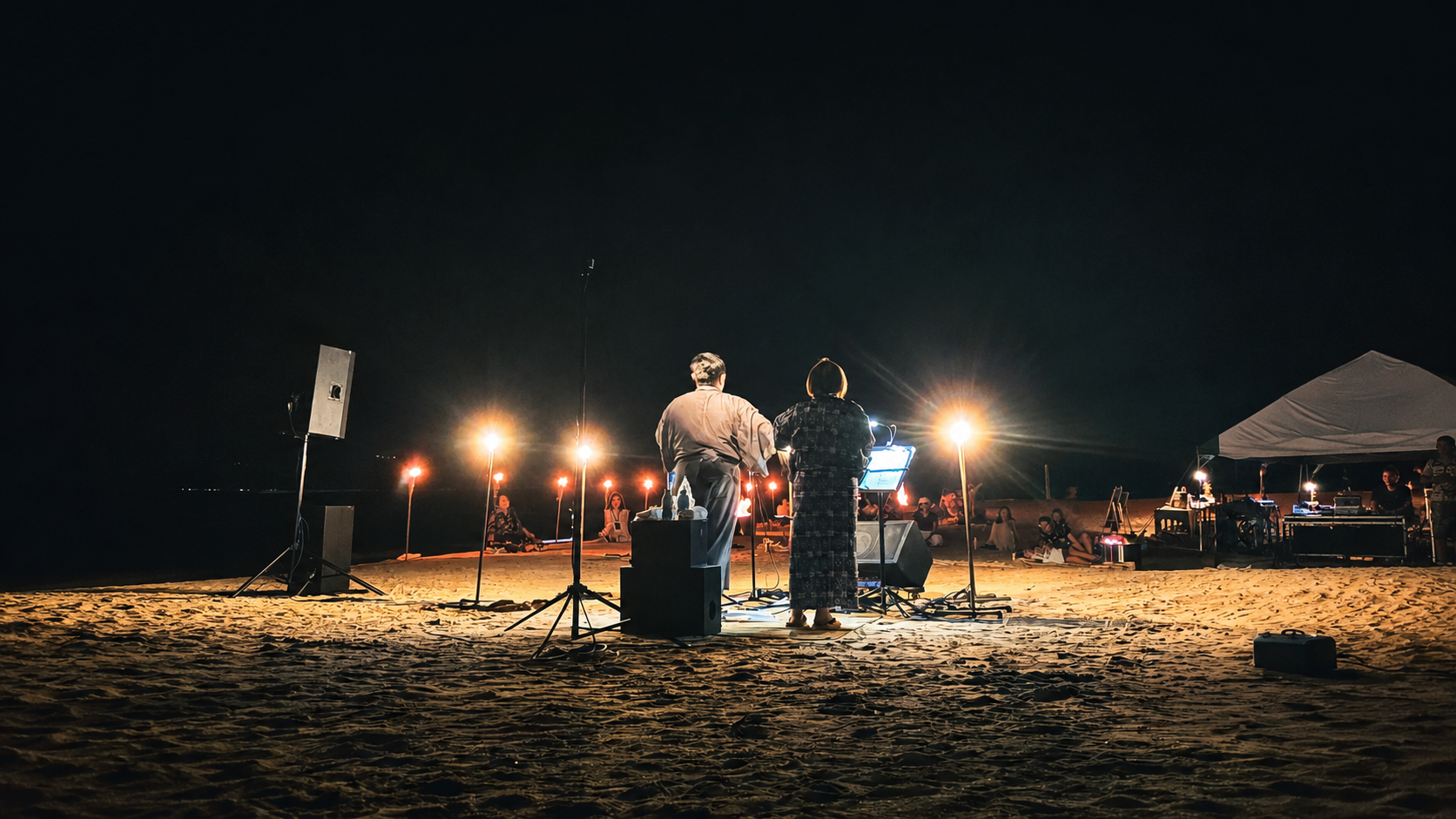
光、空、海、土地、楽器、人。
石垣島で六年。
このビーチで、数えきれないほどのライブを主催してきました。
光、空、海、土地、楽器、人。
そのすべてが、ただここにある。
夕方の自然の光のなかで、
楽器を奏で、うたい、空と海に向き合う人がいる。
わたしはつまるところ、
こういうことが大好きなのです。
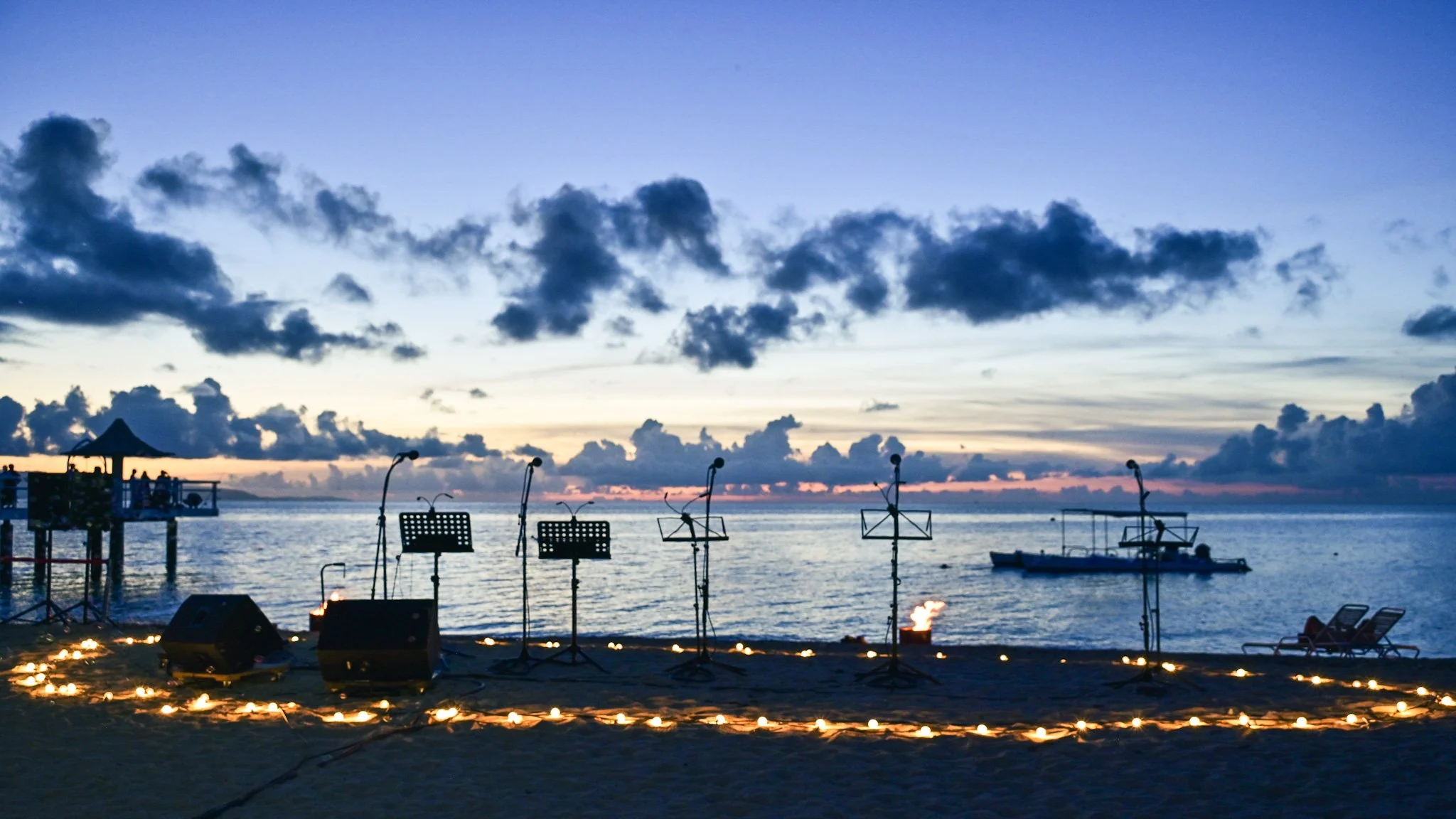
Light, sky, sea, land, instruments, people.
Six years on Ishigaki Island.
I’ve hosted more live performances on this beach than I can count.
Light, sky, sea, land, instruments, people.
All simply here, together.
In the evening light,
people play and sing, with the sky and sea before them.
When it comes down to it,
this is what I love.
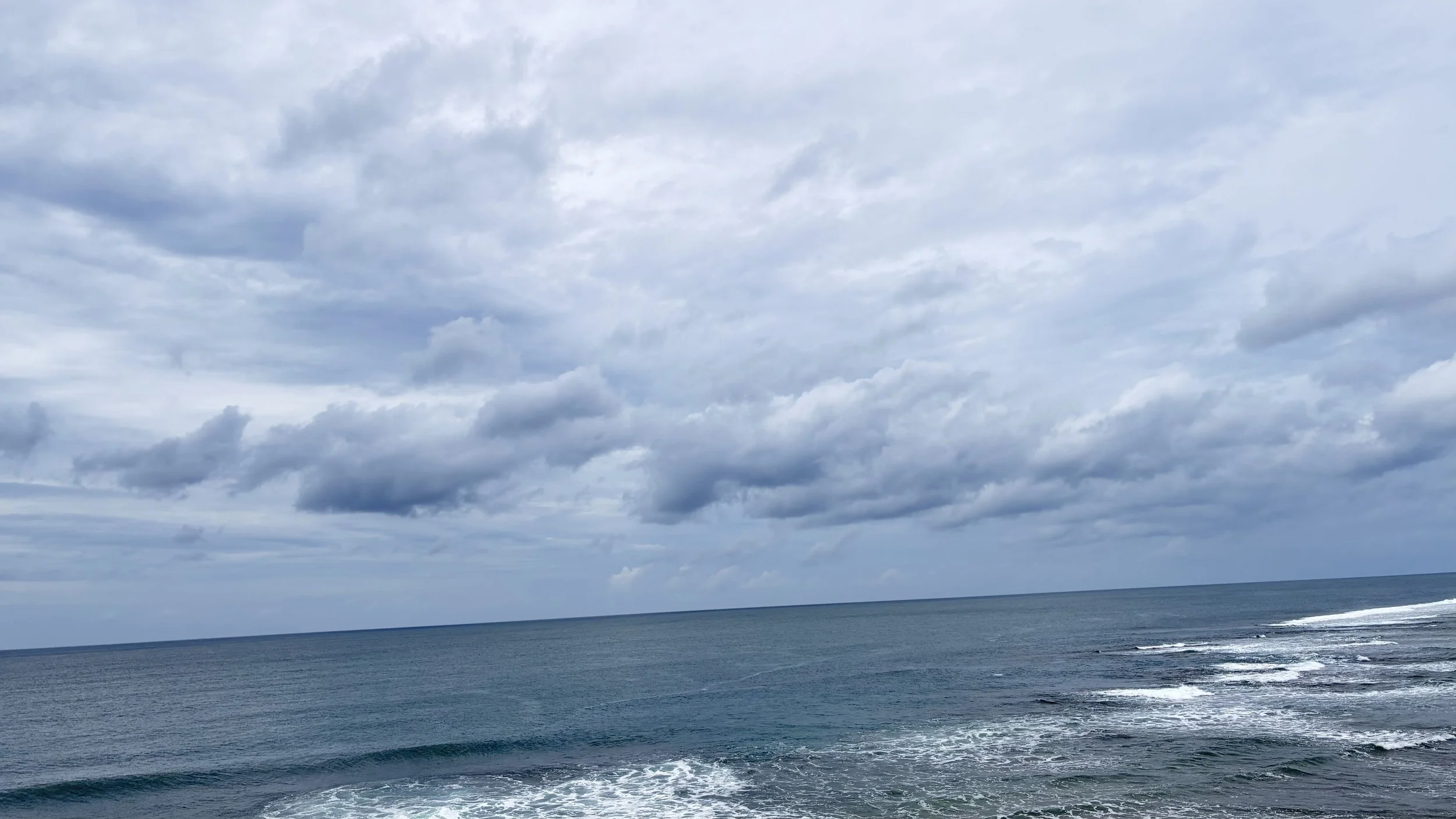
Listening Across Distance — II
The Void Between Us Is Not Empty
Yesterday, I wrote about two pieces of music.
A blue pearl suspended in the darkness of space. An emerald boat moving across the sea. One reached me through Will. I sent the other back across the distance. They were not created for one another. Their composers did not know that the two pieces would ever meet. Yet they met inside one act of listening.
Today, I want to remain with the space between them.
Chihei Hatakeyama’s Void series has always resonated deeply within me. Each work is beautiful, but its depth does not come from trying to fill every space.
The music leaves room.
Sound, memory, weather, and distance are allowed to remain without being forced into a conclusion. The word void can suggest absence, emptiness, or something missing. But in Chihei’s music, I do not experience it as nothingness. I experience it as a field of possibility.
A space in which a faint sound can continue.
A distance across which something may still be felt.
Perhaps the void between us is not empty.
It is the space in which resonance becomes possible.
There is a void between one person and another.
Between one island and the next.
Between the Earth and the darkness surrounding her.
Between the night of March 3 and the morning when Will’s message reached me.
Between a sound being made and someone, somewhere else, becoming ready to hear it.
These distances do not always need to be overcome.
A bridge tries to take us across a distance.
Resonance allows the distance to remain.
Two sounds do not have to become identical in order to respond to one another.
Two people do not have to share the same body, language, history,
or understanding for something to pass between them.
Resonance is not sameness. It is a relationship between things that remain distinct. Perhaps that is why a small knot feels more truthful than a completed circle.
A circle returns us to where we began.
A knot does something different.
It allows two separate threads to touch, hold one another for a moment, and then continue in their own directions.
The blue pearl remains the blue pearl.
The emerald boat continues across the sea.
Will remains on his shore.
I remain on mine.
Yet something has passed between us.
The knot does not explain the universe, the island, the music, or the people connected by them. It simply keeps them from passing one another unnoticed. On March 3, I thought Island Echo was beginning as a program. Now I wonder whether something else also began that night. Perhaps it was the first sound being sent into the distance. The performance ended. The stage was cleared. The eclipse passed.
The people who had gathered returned to their separate lives. But the sound continued. It traveled with Chihei to another island. It entered a new Void.
Months later, a song from Will gave me a way to hear it again. Only then did I understand that Island Echo had not ended with the event. Its name had become literal. The island had echoed. An echo is not the original sound repeated unchanged. It is a sound after it has encountered distance. The shape of the place alters it. Time alters it. The body receiving it alters it. By the time an echo returns, it is both the same sound and something new. Perhaps correspondence works in the same way. A letter leaves one person without knowing precisely how it will be received. It enters another person’s life, another history, another language, another moment.
The reply is not a copy. It is the original message after it has passed through someone else’s interior world.
A human being always listens alone.
No one can hear exactly what another person hears.
We inhabit separate bodies, carry private memories, and stand on different shores.
Music does not erase that solitude.
It gives solitude a form that can travel.
A song becomes a letter.
Someone opens it.
Then, from another shore, another sound is sent back.
This does not cure loneliness.
Perhaps loneliness is not something that can—or should—always be cured. It is part of the boundary of being a person. But music can keep that boundary from becoming a wall.
It allows us to remain separate without becoming unreachable. Listening is not the promise that we will completely understand one another. It is the willingness to let what another person sends enter us without immediately possessing, translating, or reducing it. That is also what moved me in Pérola Azulada. The Earth is not presented as an object that belongs to us. We belong to her. We live within her light, water, weather, and living body. The song asks us to respect the life she carries, not because it is ours to control, but because we are already part of it. Perhaps the ethics of belonging and the ethics of listening are closer than they first appear.
We cannot possess the Earth.
We cannot possess another person’s meaning.
We can receive.
We can listen.
We can care for what has been entrusted to us.
And we can reply.
Perhaps coincidence becomes correspondence in precisely this way. Not because we declare that two distant things were destined to meet. Not because we force them into the same story. But because someone notices a resonance and answers it with care.
One song arrived as a gift.
Another was sent in return.
Between them, something in my own life became audible again. The blue pearl connected the human body to the Earth. The emerald boat connected the human body to distance. The two pieces formed a small knot between the planet and the island, the universe and the sea, another person’s listening and my own. They did not resolve the distance. They allowed me to hear it. Perhaps this is what it means to listen across distance.
Not to make the faraway suddenly near.
Not to pretend that solitude has disappeared. But to recognize that the space between us may already be carrying something.
A memory.
A question.
A piece of music.
A letter that has not yet been opened.
Tonight, the Earth is still floating in the darkness—a small blue pearl. Somewhere upon her water, an emerald boat is moving.
On one shore, someone sends a song.
On another, someone opens it.
The echo continues.
The void between us remains.
But it is not empty.
We remain alone.
But we are not unreachable.
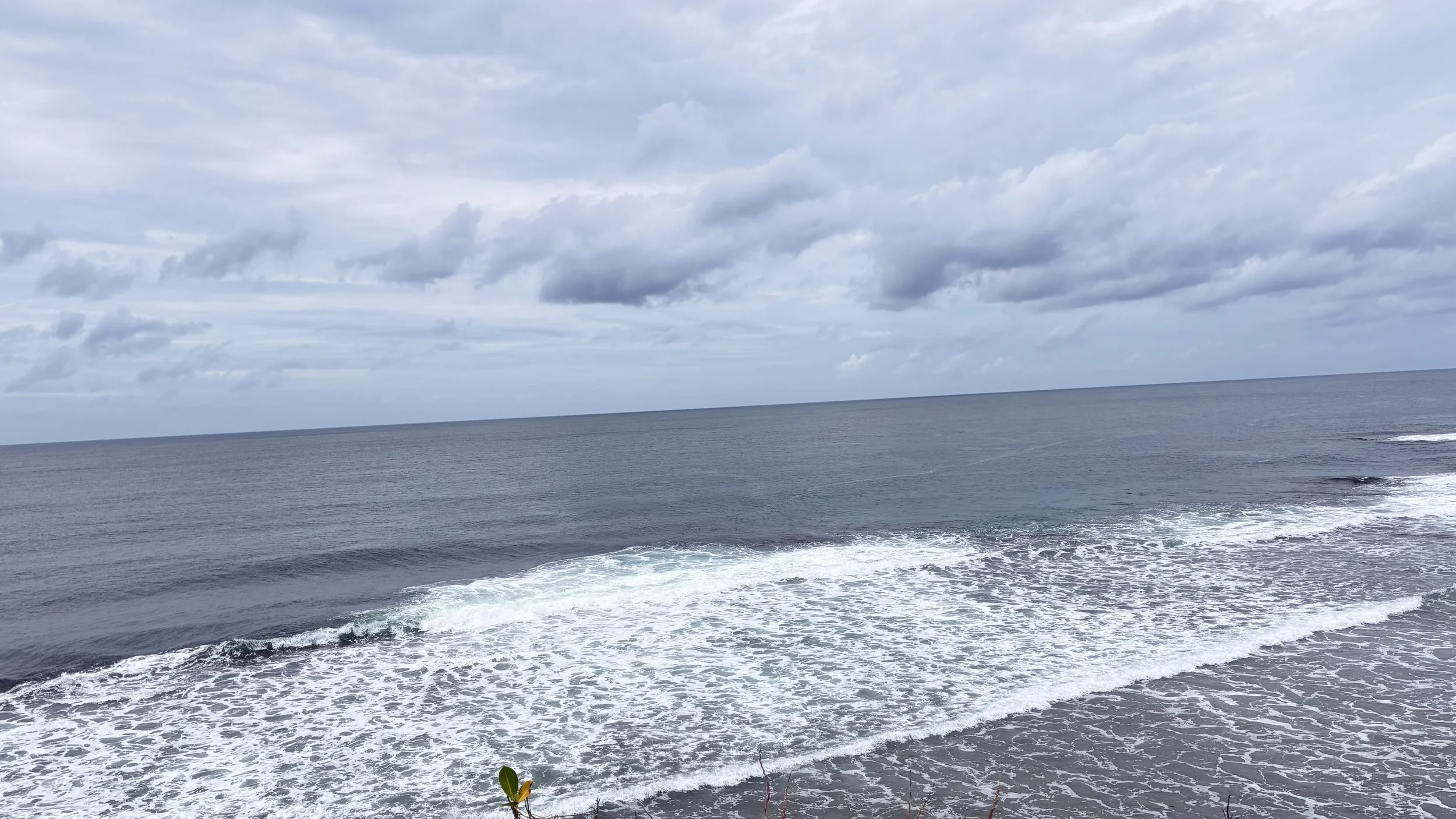
Listening Across Distance — I
A Blue Pearl and an Emerald Boat
For some time, I had been writing almost entirely for work.
Day after day, I looked at photographs of the sea, sunsets, and moonlight. I searched for words that might help someone else imagine an island night. I was paying close attention to light, water, weather, and the movement of time. Yet somewhere inside all that attention, I had stopped looking at my own life. I was writing about the sea, but I was no longer listening to what was moving inside me.
Then a message arrived from Will. He told me that reading my messages felt like receiving a virtual letter—something that delighted him each time he opened one. At first, I did not know how to answer. Perhaps because his words named something I had been trying to do without fully knowing it.
I want to live as though I am writing a real letter. Not only when I sit down to write, but in the way I listen, remember, and offer something of myself to another person.
His message did not solve anything.
It simply found me.
It reminded me that beneath all the words I had been writing for work, there was still a person here who could receive a letter—and reply. Will wrote about Japan and its attention to the small details of life. He wrote about Thailand, where he feels a sense of comfort and peace, and about the places at Wonderfruit that he hopes we might enjoy together one day. He also told me that it was only in the past three or four years that he had begun to understand what it meant to listen truly and to live in the moment.
There was still so much more for him to explore. He asked for my music recommendations. Then he sent me Pérola Azulada, performed by Thays Sodré with Toninho Horta.
Will said that sharing a song he loves feels like treating a friend to a meal or a drink. I pressed play. At first, I did not search for its meaning.
I simply listened.
Thays Sodré’s voice felt extraordinarily gentle and close. Toninho Horta’s guitar did not seem to sit behind her voice; it seemed to listen beside it. The whole ensemble breathed as though it were part of an intimate conversation already in progress. When I began to understand the Portuguese words, the music moved even closer.
Pérola Azulada means a pearl tinged with blue. The song imagines the Earth as a small blue pearl suspended in the darkness of space—precious, vulnerable, and alive.
The Earth is beloved.
She is mother.
She is the many forms of shelter human beings have made across different climates and cultures, and the one home that contains them all. The person singing learns to move within her, to rest when the journey has reached the bones, to live close to dawn, to swim in her blue waters, and to respect the life carried inside her.
Light, water, body, animal,
and human life are not separated. They exist within one another. The Earth is not something for us to possess. She is something we belong to. And then the song leaves us with a small, piercing question:
How many others will learn to live this way?
Its tenderness contains an urgency. The song does not raise its voice. It does not begin with an argument, a warning, or an accusation. It begins with affection.
Before responsibility, there is relationship.
Before protection, there is the recognition that we already belong to what we are trying to protect. I keep returning to one phrase:
A bênção, minha mãe.
A child asking their mother for her blessing. What moves me is its intimacy. The Earth is not addressed as an abstract idea or a distant sacred symbol. She is close enough to speak to. Close enough to ask for a blessing. Perhaps that is why the voice feels so personal. It is not singing about the Earth from somewhere outside her. It is singing from within.
I wanted to answer Will with music. Not by explaining what his song had made me feel, but by replying in the same language in which it had reached me. He had placed one song on the table. I wanted to place another beside it. The piece I chose was “Emerald Boat” by Chihei Hatakeyama from his latest album, Void XXIX.
On March 3, 2026, during a total lunar eclipse, Chihei Hatakeyama and JYTM performed here in Yaeyama. That night, Island Echo of this year began. The sky, the sea, the wind, and the darkness came first. The music was not there to take command of the night. It was there to listen with us.
After the performance, Chihei continued to Iriomote Island, carrying his recording equipment. Iriomote has no airport. To reach it from Ishigaki, one must cross the sea. The crossing is not especially long. Yet traveling by boat restores something that air travel often removes: the physical sensation of leaving one place and arriving somewhere else.
The body feels the distance.
The shore recedes.
Another shore slowly approaches.
On Iriomote, Chihei spent time making field recordings, listening through the rain, the coastline, the water, and solitude. The journey became part of the background to his new work.
Void XXIX is not simply a documentary portrait of Iriomote. What it carries is more elusive: the sensation of being on an isolated island, separated from the place one normally inhabits, and the uncertainty of knowing where one truly is.
How does a human being know where they have arrived?
Through a map?
Through a name?
Through the duration of a journey?
Or through the moment when the body finally feels the distance it has crossed?
From this work, I chose Emerald Boat. In it, I do not hear a postcard from an island.
I hear someone listening alone at its edge.
I hear the distance between one shore and another.
I hear a body surrounded by water, trying to understand where it is.
Perhaps it is only a coincidence.
But the two pieces seemed to meet somewhere inside me.
A blue pearl suspended in the darkness of space.
An emerald boat moving across the sea.
One piece looks toward the Earth from the vastness of the universe. The other travels across her water. One reminds us that we do not own this living planet; we belong to her. The other asks how a solitary human body knows where it is.
Between them are light, water, distance, the body, and the fragile fact of being alive. They were not written for one another. Their creators did not know that this connection would occur. One piece reached me through Will. I sent the other back across the distance.
Will, thank you for receiving my words as letters. You could not have known how much I needed to hear that. Thank you for offering me Pérola Azulada with the warmth of sharing a meal. Thank you for placing its blue pearl, its water, its tenderness, and its quiet question in my life.
Chihei, thank you for the continuing depth of the Void series. Thank you for coming to Yaeyama on March 3, for sharing the night of the total lunar eclipse with JYTM, and for carrying your journey onward into sound.
What began as one friend sending another a song became a small knot between March and August, a Brazilian song and the sea of Yaeyama, the universe and a solitary human body.
The two pieces remain separate.
Yet for a moment, they touch.
The space between them does not feel empty.
現実を 書き換えない。
私の現実、あなたの現実。
それぞれの現実を尊重したい。
少し外れた音。
揺れた声。
走ったテンポ。
不安定だった一瞬。
そして、それを直したくなる。
その気持ちはよく分かる。
作品を世に送り出すなら、
できるだけ美しいものにしたい。
けれど、ライブには、
作品とは少し違う役割と魅力があるのかもしれない。
だからといって、
何もせず、そのまま出せばいいわけでもない。
隠さない。けれど、雑に見せない。
ノイズを整える。
聞きづらい帯域を少し抑える。
その夜の空気を壊さない範囲で、
音を美しくする。
けれど、
その人が本当に鳴らした音まで
別のものに変えてしまわない。
私はライブを見るとき、
完璧だったかどうかは、それほど見ていない。
もちろん、間違ったらわかる。
でも、間違ったあと、
演奏者がどうするかを見ている。
すると、
その人がステージに立ったとき、
空気をつくれるかが見えてくる。
声に説得力があるか。
演奏者と、その演奏表現に、
本当にオーガニックな関係があるか。
いや、これは少し形而上的で、わかりにくい。
一言で言えば、
その場所で、
音楽が生きているか。
それを見ている。
だから、少し風が入っていてもいい。
声が少し揺れていてもいい。
音のバランスが、
完全ではなくてもいい。
その夜にしかなかったものが
そこに残っている方がいい。
現実を美しくすることはあっても、
現実を書き換えない。
たぶん、それは音楽だけの話ではない。
私も、そしてたぶん皆、
自分の弱さや未完成な部分を
なるべく見せたくない。
けれど、本当に誰かの心を動かすものは、
完璧に整えられた姿ではなく、
それでもそこに立っている
人の姿なのだ。
自信というものも、
自分に言い聞かせて生まれるものではないのだろう。
何度も立つ。
失敗する。
それでも続ける。
誰かの音を聴く。
自分の声に戻る。
そういう時間の積み重ねが、
いつか身体の中に残る。
そしてある日、
自分の演奏を見返したときに、
ここを直さなければ、
ではなく、
あの夜は、ちゃんと生きていた。
そう思えるようになるのかもしれない。
それに気づくかどうかは、
結局、その人自身にしか決められない。
誰かが教えてくれることでもない。
だから私は、
自分が何を信じているのかだけを
ここに残しておこうと思う。
隠さない。けれど、雑に見せない。
現実を美しくすることはあっても、
現実を書き換えない。
そして、これは誰かの音楽を見ながら、
自分自身に言っていることでもある。
もし、もう一人の自分がいればいいのに、
と思うことがある。
自分を少し離れたところから見て、
大丈夫だ、と言ってくれる自分が。
けれど結局、
自分の敵も、
自分を許す人も、
自分の心の中にしかいない。
Do Not Rewrite Reality
My reality, your reality.
I want to respect each for what it is.
A note slightly out of tune.
A trembling voice.
A tempo that rushes.
A moment of uncertainty.
And then comes the urge to fix it.
I understand that feeling.
When we send a work out into the world,
we want to make it as beautiful as we can.
But perhaps a live performance
has a different role,
and a different kind of beauty.
That does not mean
we should leave everything untouched.
Do not hide it.
But do not present it carelessly.
Clean up the noise.
Soften the frequencies that are difficult to hear.
Make the sound more beautiful,
as long as the atmosphere of that night remains intact.
But do not turn
what someone truly played
into something else.
When I watch a live performance,
I am not particularly interested in whether it was perfect.
Of course, I notice mistakes.
But what I watch is
what the musician does after the mistake.
That is when I begin to see
whether this person can create an atmosphere
simply by standing on a stage.
Does the voice carry conviction?
Is there a truly organic relationship
between the performer
and the way the music is expressed?
No.
That sounds too metaphysical.
Put simply:
Is the music alive
in that place?
That is what I am looking for.
So a little wind in the recording is fine.
A voice can tremble.
The balance of the sound
does not have to be perfect.
I would rather something remain
that could only have existed on that particular night.
We may make reality more beautiful,
but we should not rewrite it.
Perhaps this is not only about music.
I, and probably all of us,
would rather not reveal
our weaknesses or the parts of ourselves
that are still unfinished.
But what truly moves another person
may not be a perfectly polished image.
It may simply be
the sight of someone
who is still standing there.
Confidence, too,
is probably not something
we can talk ourselves into.
You stand there again and again.
You fail.
You continue anyway.
You listen to someone else’s sound.
You return to your own voice.
Those accumulated moments
eventually stay somewhere in the body.
And perhaps one day,
when you watch your own performance again,
instead of thinking,
I need to fix this,
you may find yourself thinking,
That night was truly alive.
Whether someone comes to understand this
is ultimately something
only they can discover for themselves.
It is not something
another person can teach them.
So I will simply leave here
what I believe.
Do not hide it.
But do not present it carelessly.
We may make reality more beautiful,
but we should not rewrite it.
And while I may be thinking about someone else’s music,
I know I am saying this to myself, too.
Sometimes I wish
there were another version of me.
Someone who could stand a little farther away,
look at me from a distance,
and say,
You are all right.
But in the end,
the person who stands against me,
and the person who can forgive me,
both live
inside my own heart.
Hojicha at Night
Boil the water.
Pour it over the leaves.
Let the roasted aroma rise.
Wait for it to cool, then drink.
The warmth of hojicha’s aroma comes in part
from pyrazines formed during roasting.
Not to make myself sleep,
but to let the day quietly come to an end.
Aroma, warmth, and a small ritual.
負を引き受ける
「負を買いなさい。先に負をもてばいいじゃないですか。
誰にだって負はあるんです。
それをちゃんと自分で意識しようじゃないですか。」
——松岡正剛『正負の法則』『負の先払い』について
東京から西表島へ。
西表島から石垣島へ。
西表島までの時間は、ずいぶん恵まれていたと思う。
だから石垣島で、大きな負を払っているのだろうか。
そんなふうに考えることもある。
けれど、人生は帳尻合わせではないのかもしれない。
これは自分の負だ、と静かに引き受けてみる。
消そうとせず、誰かに返そうともせず、抱えたまま歩いてみる。
すると負は、罰ではなく、
これから何を選ぶのかを支える重しになる。
五十を越えて、ようやくそのことを学んでいる。
そして今、「月と波のこと。」を始めている。
すべてが軽くなったからではない。
負を抱えたまま、それでも大切なものを選び始めたのだ。
もしかすると、
これが「負の先払い」なのかもしれない。
避けられないものを引き受けることで、
これからの人生を、少し軽やかに生きるための。
What We Choose
For a long time, whenever something did not work,
I tended to see it as a problem with people.
Why does this person do things this way?
Why can’t we understand each other?
Why does the same problem keep returning?
Lately, I have begun to see it differently.
When I see it as a problem with people, I become frustrated.
When I see it as a problem of structure, I can understand it.
When I see it as a matter of my own choice, I can move forward.
No one needs to become the villain.
People have their own ways of working,
and organizations are shaped by what they have allowed to become normal.
And we, too, are free to choose
where, with whom, and how we want to work.
I want to work in places where responsibility and authority are clear,
where only the words that matter need to be spoken,
and where people can move quietly.
Quiet does not mean that nothing is happening.
Quite the opposite.
It means that people know their roles,
and things can move naturally
without someone constantly having to raise their voice.
Perhaps that is where good work begins.
Soon,
Yaeyama will enter one of its busiest weeks of the year.
People will arrive from everywhere.
The island, the sea, and the town will become full of movement.
And that is precisely why
I do not want busyness to take this summer away from me.
I want to notice the morning light.
Feel the wind.
Look at the sea at sunset.
Find the moon when night comes.
I do not have to solve everything.
I can take responsibility for what is mine,
and let go of what is not.
And through it all,
I want to remember what it means to be here.
Summer in Yaeyama does not begin
when the work is finished.
It is already here, inside the day itself.
What We Choose | 私たちが選ぶもの
長いあいだ、うまくいかないことに出会うたび、
人の問題として考えていたように思う。
なぜ、この人はこうするのだろう。
なぜ、伝わらないのだろう。
なぜ、同じことが繰り返されるのだろう。
けれど最近、少し違う見方ができるようになった。
人の問題として見れば、腹が立つ。
構造の問題として見れば、理解できる。
自分の選択の問題として見れば、次へ進める。
誰かを悪者にする必要はない。
人にはそれぞれの働き方があり、
組織には、それを許容してきた時間がある。
そして私たちにも、
どこで、誰と、どのように働くかを選ぶ自由がある。
私は、責任と権限が明確で、
必要な言葉だけが交わされ、
人々が静かに動ける場所で仕事をしたい。
静かであることは、何も起きていないということではない。
むしろその逆だ。
一人ひとりが自分の役割を知り、
誰かが声を張り上げなくても、
物事が自然に動いていく。
良い仕事とは、
そういう場所から生まれるのかもしれない。
もうすぐ、八重山に一年で最も賑やかな季節がやってくる。
たくさんの人が島を訪れ、
島も、海も、町も忙しくなる。
だからこそ今年は、
忙しさに夏を奪われないようにしたい。
朝の光を見る。
風を感じる。
夕暮れには海を見る。
夜になったら月を探す。
すべてを解決しなくていい。
わたしが引き受けるべきものを引き受け、
そうでないものは手放していく。
そして、この島にいるということを、
ちゃんと味わっていたい。
八重山の夏は、
仕事が終わったあとにあるのではない。
この一日そのものの中にある。
身体は、まだ回復することを知っている。
わたしは長い間、
自分がもう深く眠れなくなったのだと思っていました。
けれど、
立ち止まり、
休み、
食べ、
身体の声に耳を澄ませた数日のあと、
私は七時間続けて眠ることができました。
今回、本当に大きな発見だったのは、
足首が治り始めたということではありません。
(一昨日、ビーチで捻挫をわたしはした)
私の身体は、まだ回復することを知っていた。
“Let nature take the lead. Let music follow.”
このわたしの最近の心の中にいつもある言葉は、
月や波や音楽のことだけではなかったのかもしれません。
自然とは、
私たちの外側にあるものだけではなく、
自分自身の身体でもあります。
自然のリズムを取り戻すとは、
新しい自分になることではなく、
もともと身体が知っていたリズムを、
もう一度思い出すことなのだと思います。
My Body Still Knows How to Heal
For a long time,
I believed I had forgotten how to sleep deeply.
Yet after being forced to stop,
after resting, eating well,
and allowing my body to recover,
I slept for seven uninterrupted hours.
The most important discovery was not that my ankle would heal.
It was that my body still knows how to heal.
Perhaps
let nature take the lead.
Let music follow.
It was never only about the moon, the sea, or music.
Perhaps
it was also about listening to the quiet rhythm within myself.
Nature is not somewhere outside of us.
Our own body is part of nature.
Recovering its rhythm is not about becoming someone new.
It is simply to remember
the rhythm that has always been there.
‘Say it to me now’
I still remember the first time I watched “Once.”
I cried.
Not because it was a sad film,
but because it reminded me that music could be a way to live.
Glen Hansard didn’t simply write songs.
He reminded many of us that an honest voice is enough,
that beauty doesn’t need to be loud,
and that hope can begin with a single guitar and a single heart.
Years have passed,
but his music has stayed with me,
quietly shaping the way I think about life and the path I want to follow.
Thank you, Glen.
Your songs will continue to accompany people
between sunset and moonlight.
Rest in peace.
p.s.
Because of you, I never stopped believing that a life devoted to music was possible.
あなたのおかげで、
私は音楽に人生を捧げるという希望を、
信じることをやめませんでした。
Glen Hansardは、多くの人の人生に静かな灯をともした人でした。
アイルランド、世界中の音楽家たちから深い追悼の声が寄せられています。
わたしもここに記します。